
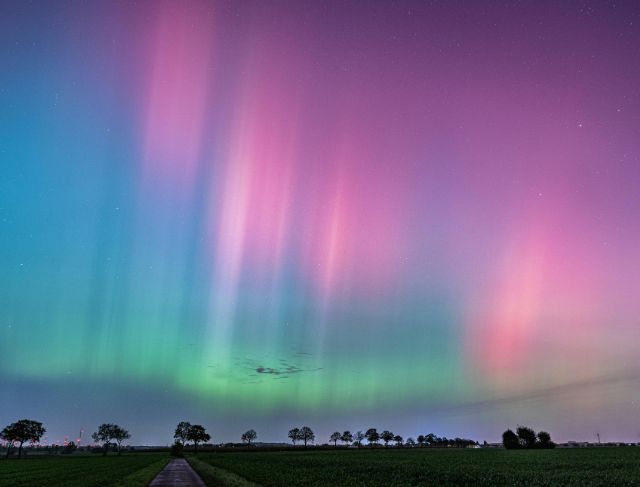
2026 could be your best chance ever for seeing the Northern Lights if that’s been on your wish list for some time! Experts say this will be one of the greatest times in 10 years for seeing some of the brightest and most impressive auroras.
So, if you dream about seeing multicolored lights twinkling in the sky, you will have a chance in 2026!
To really have a chance of seeing the Aurora Borealis, just remember to go north, choose dark moonless nights, get out of busy cities, and stay for a while to wait for the skies to work in your favor.
People get frustrated when they cannot see the auroras when they travel north because they miss one or two of these four key elements.
The Aurora Borealis depends on the sun’s 11-year solar cycle which causes sunspot activity to increase, which, in turn, leads to a stronger geomagnetic storm. Experts believe the peak of solar activity happened around 2024 and that the most active auroras will occur around 2026-2027.
This will create more solar storms and therefore more opportunities to see bright auroras.
As a result, photographers and travelers are excited.
Wil Cheung, a professional aurora photographer, has been lucky to see the Northern Lights more than 400 times in several different countries from as far south as northern France to as far north as the Artic.
Scientists refer to the best locations for experiencing the Aurora Borealis as the “aurora oval,” which is an area shaped like a ring The aurora oval surrounds the north pole where you will find the highest frequency of auroras.
Some frequently visited locations in the aurora oval are Norway, Finland, northern Sweden, Greenland, northern Iceland, Canada, and Alaska (USA).
The most famous place to go see the aurora borealis would be Tromso, Norway, because Tromso lies directly within the arctic circle.
Some travelers prefer Akureyri, Iceland, because it has the best location but with more potentially clear skies.
Sometimes, an unknown place will provide you with a better experience.
Statistically, aurora activity is higher from March 21 to September 21 due to the high probability of geomagnetic storms during this time frame. However, darkness is also an important factor.
Auroras are best observed under very dark skies.
Travelers should plan their trips on nights with little to no moonlight to maximize the visibility of color in an aurora.
A bright moon will wash out the color of the aurora completely.
Thus, scheduling your trip around the lunar phase is just as important as selecting a good location.
Generally speaking, auroras do not follow a definitive schedule, and they typically produce waves. The light can be dim most of the time, but then suddenly become large displays of brilliant colors that move across the sky.
This explosion of energy is referred to as the expansion phase.
You greatly increase your chances of viewing an aurora if you’re spending the night in an area without any artificial light.
If you have a limited amount of time to travel, there is a chance you may miss it completely.
Generally speaking, even small towns can lessen your chances of seeing an aurora because artificial light will increase the brightness of the sky.
Travelers typically rely on Light Pollution Maps to help them find the darkest place possible when looking to view an aurora.
If there is a city to the north of you, it can be very bright, greatly reducing the contrast between the aurora and the background of the sky.
If you want to view the aurora, you need clear skies. Cloud cover will totally block out the aurora, regardless of how much solar activity is present.
This is why many experienced aurora travelers book flights shortly before they are scheduled to leave, once they have checked the weather.
The aurora viewing season usually coincides with the low travel season in countries such as Norway and Iceland, so even when booking flights last minute, fare prices may still be lower than they would be during busier tourism seasons.
Watching the Northern Lights (Aurora Borealis) is a combination of science, patience, and strategic planning. Factors to think about when experiencing the Aurora Borealis include selecting the appropriate place, the right time of the year, keeping yourself away from light pollution, considering both the weather conditions, and allocating enough time to be outdoors to allow for adequate chances of viewing them.
If you have carefully considered all these factors, possibly you will be fortunate enough to witness one of the most spectacular sights on our planet.
When those greens and purples begin to weave themselves through the skies above you, your efforts will definitely make their worth apparent.


