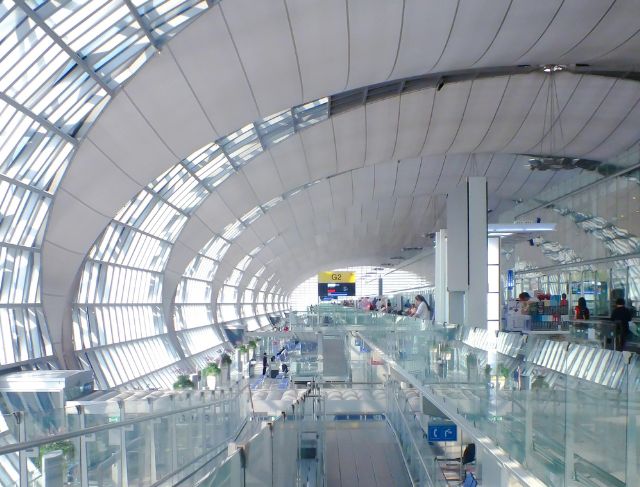
The majority of passengers think of airport as a place where individuals arrive to embark on a journey at the present time in South Korea Incheon International Airport has been transformed into a rather unusual station during extremely hot weather conditions, since some aged people began spending time in the terminal to keep away from the high temperatures outside.
However, there was no purpose to use this terminal for the journey.
There are many ways that these people occupied themselves. Some played games on their devices or had meals which they had prepared at home. Some of them were just relaxing on their seats in the terminal enjoying the air conditioning. The terminal became a great place for escaping from high temperatures.
According to the statement of the Korea Meteorological Administration, such high temperature as 42.5 degrees Celsius was recorded in Yangsan on August 2, which is about 310 kilometers away from Seoul and is considered to be the highest temperature recorded in the country in the history of the country.
And now Incheon Airport comes into the picture.
The airport is situated around 50 km from the downtown in Seoul which makes it an easily reachable destination. Moreover, citizens who are 65 years and above can travel for free to the airport using public transport in Korea. Thus, it is a cost-effective option during summer.
Surprisingly, the situation at the airport is quite different.
While the airport is usually rushy with passengers trying to catch their flights, some senior citizens are idling away their time at the airport. It became a cool resting place for many.
It is easy to see that finding shade in the hot summer weather is not a bad idea. But for the airport authority, it is different from that.
According to Incheon International Airport Corporation, more and more people, who are not in transit, are visiting the terminals and staying there for a long time. These people create an additional burden for the airport personnel responsible for cleaning, waste disposal and supervision of the premises.
The airport was getting ready for an unusually active summer travel season.
From July 25 to September 10, Incheon Airport expected around 3.77 million passengers using its services, which translates into around 222,000 passengers per day.
Thus, the availability of space in the terminal was really important.
The case was made more complicated by the fact that on top of the many travelers passing through, the airport had to deal with the issue of homeless people who found the terminal a good place to escape the heat. Starting on July 30, the airport had started putting up notices on the items left behind by the homeless who spent a night in the airport.
The notices mentioned the prohibition of sleeping or staying at the airport, and said that people who had no reason to be at the terminal were more than welcome to leave.
In the warning it was stated that failing to comply may lead to fines, imprisonment, or other legal repercussions, respectively.
However, the fact that people were prohibited from staying there was not enough to solve the problem.
The heat was still there, and the airport remained a good hideout for a homeless person seeking for place to stay.
There was a limitation in theory and practice.
The authorities could not facilitate forced surgeries.
An IIAC representative noted that notices from the authorities were being used as guidance and were not being used to evict people.
The airport sought the cooperation of the Incheon municipality.
On the other hand, the case of elderly visitors was slightly different.
Many of them weren’t homeless or didn’t plan to sleep in the airport; they were looking for the ways to escape a scorching heatwave.
Some of them stayed inside the terminal for a considerable period of time having food with them and finding a place to sit down. For them, the airport was not fully about planes, but more about preventing themselves from suffering from unbearable heat.
This factor features distinctive characteristics.
The airport is a public facility by nature, and its operators understood that it would remain open for all. Nevertheless, the facility was primarily intended for the use of passengers, airport staff, and those accompanying travelers.
When there appear thousands of additional people using it, it puts much pressure on the facility.
Cleaning becomes more challenging.
There is a rise in garbage.
Personnel needs to oversee a large number of areas.
People at the airport also need to cope with people who are not catching any flights.
And the timing could not be more inappropriate.
Incheon Airport was about to enter one of the busiest travel periods in summer, with millions of passengers anticipated over a few weeks. Even in a normal situation, managing such a huge number of people would require considerable planning.
And now we must deal with a strong heat wave.
First of all, it poses a complicated question of airport management.
When air temperature rises drastically, there are many places where we can find normal air conditioning. Shopping centers, libraries, stations, and airports can become informal oasis for people in need, especially the elderly and other vulnerable groups.
Incheon just happened to be a big and convenient air-conditioned location.
The story sounds ironic as well.
Usually people hurry to leave the airports as fast as they can. The only thing they want is to check-in and pass boarding.
Nevertheless, in this heat wave people did not hurry to leave the airport.
Some
They took their seats.
They had meals.
They enjoyed games.
They hoped for the outside temperatures to become bearable.
For elderly travelers, the cooling system at the airport is a temporary solution for the problem at hand. The increase in the number of people who are not traveling shows the effects the weather may bring to how people use the public infrastructure.
The question is what happens next if the current weather persists.
One hot day is not a big deal.
One hot season is different from one hot day.
With days of extreme temperatures behind their backs, those people, who do not have any cooling in their houses may see no options. Elderly people are more likely to be affected, so availability of preventive places is becoming more and more important.
The issue is that the airport managers find themselves between a rock and a hard place.
They must provide comfort to millions of passengers while dealing with those who are looking for a shelter from the extreme heat.
They have to take care about homeless people too.
Just telling people to leave the airport does not make the weather disappear.
This makes the situation at Incheon Airport something
It is also a depiction of how extreme temperatures can impact our daily lives.
Record temperatures in South Korea have turned an airport into an unlikely destination for those seeking some respite from the heat. Senior citizens have discovered that the airport’s benches provide an opportunity to take a break and people who are homeless have sought refuge in the buildings of the airport.
However, airport officials have indicated that airport terminals cannot be converted into permanent lodging.
This creates the dilemma of how to offer help to those in need without harming the airport’s preparations for the arrival of thousands of tourists every day.
For the moment, the air conditioning at the Incheon International Airport remains the biggest draw for people to come there.
However, they are not traveling there to catch a flight.
They are going there because it is often the case during the hottest heatwave period in South Korea that the most comfortable place is the airport.