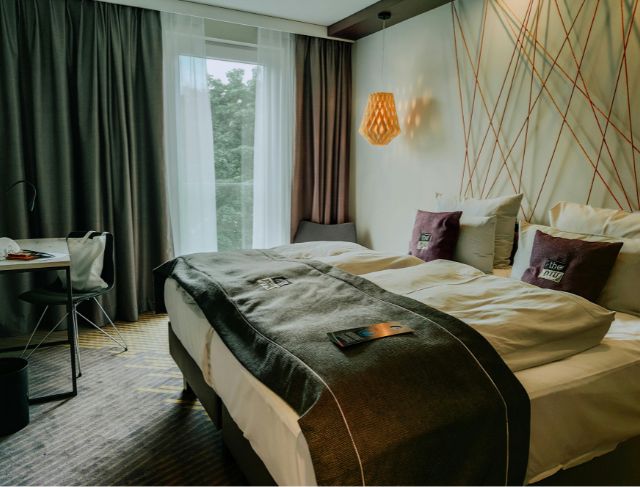
A hotel room can provide the ideal opportunity to unwind following a long day of travel. Everything is in perfect order, and you are all set for a relaxing night’s sleep.
However, in some situations, sleep can be elusive just as soon as you switch off the lights.
Instead of falling asleep without a hitch, you might experience a series of disturbances, such as waking up multiple times and hearing unexplained sounds.
Such phenomena occur frequently with travelers and is termed as first night effect.
What Is the First Night Effect?
First night effect encompasses changes in sleeping patterns that take place when an individual sleeps in an alien environment.
The person experiencing the first night effect might have difficulties falling asleep or may wake up frequently during the night and feel exhausted in the morning.
According to Anna Wick, a senior sleep researcher at the University of Freiburg, one reason for this phenomenon is that in new circumstances, the brain remains in a state of partial readiness.
In fact, instead of heading to sound sleep right away, the brain is still vigilant.
Put simply, your body can be tired but your brain could be checking the new place for safety.
Proactive Brain in a Strange Space
In a familiar environment, the brain has already learned a lot of signals from the milieu.
You know the sounds of your bedroom at night by heart. You are aware of the usual temperature, lighting, smells, and sounds occurring during the night.
However, a hotel room is an entirely different story.
Such increased awareness may pose a challenge for entering a deeper phase of sleep.
According to Ahmad Mayeli, a researcher at the University of Pittsburgh, this “first night effect” is quite likely to happen to many travelers without one even realizing it.
In fact, studies have shown that on average, people lose around 20 to 30 minutes of sleep while sleeping away from their regular place of sleep.
But It Is Not Just About Minutes Lost
Losing half an hour of sleep does not sound like an extremely important issue.
Nevertheless, the first night’s effect manifests itself in much more than just sleeping less.
According to research, the activity of some of the brain parts related to sleep remains very high during a novel sleeping experience.
Therefore, even though a person might end staying in bed long enough, their sleep quality might still be much poorer than usual.
Thus, a person may wake up after what may seem like a normal sleep but feel much more tired than usual the next day.
Why is it Different to Sleep in a Hotel Room than at Home?
Hotels may offer higher standards of physical comfort than most residential bedrooms, yet familiarity to brain counts.
Sleep at home is always predictable, while many features of hotels might be different.
For instance, the mattress may have a different firmness level, the pillows may not be the same, a hotel room might have its own peculiar smell. Even the air conditioning system might create some sounds the person sleeping in the hotel is not used to hearing.
Even the slightest differences hinder the brain from relaxing.
That is why a five-star hotel does not necessarily mean a good night sleep.
The Sounds That Wake You Up
Noise is one of the most obvious factors that hinder sleep during the trip.
Your hotel room can be located near an elevator, stair, restaurant, road, airport, or busy corridor.
Sometimes the sounds you hear are not particularly loud, yet their unfamiliarity makes you pay attention to them.
Light is a Key Factor for Sleep
The amount of light coming into a hotel room has an amazing effect on a person’s sleep.
Streetlight may shine through a window or signs of the buildings around the hotel can be seen through a light curtain.
Some hotels may also have small lights that are switched on televisions, other electronic devices, air-conditioning control, and any useful equipment.
Even light sources from seemingly unimportant things can prevent some people from falling asleep.
Thus, it is sensible to make the hotel room as dark as possible.
Room Temperature is Important Too
When it comes to sleep quality, temperature can be also helpful.
The room that feels warm or too cold may lead to difficulties in sleeping through the night.
Travelers may also feel less familiar with the air conditioning in some cases and it may take them time to adjust it properly.
Thus, having a cool and comfortable room may help when trying to sleep in a new environment.
Travel is often exhausting by itself.
Long flight times, extensive car rides, transfers from one airport to another and a busy schedule of sightseeing and irregular eating can affect how your body will feel by bedtime.
According to psychologist Lisa Strauss, this exhaustion from travelling can negatively impact a person’s sleep even without crossing time zones.
In other words, one can have sleeping problems during his or her trip without being jet lagged.
One’s routine can already be quite different before arriving at their destination.
Anxiety Can Contribute to Sleeping Problems While Travelling
Psychological reasons can also play a role in sleep issues.
Some people might feel more anxious when away from home.
This is especially true if they are staying somewhere uncomfortable or simply unfamiliar, for example, at a relative’s house.
People who are more prone to anxieties are more likely to suffer from sleeplessness in new places.
Negative thoughts might keep them occupied all night long.
Being worried about sleep also makes it even more unlikely to fall asleep.
When you lie in bed thinking: What if I cannot go to sleep tonight?
This simple thought appears to be harmless but can increase the pressure in your mind.
You begin checking the clock.
Next, you start counting how many hours are left until you have to wake up.
Your mind starts worrying about how tired and exhausted you will feel in the morning.
A little time passes and you realize that making yourself sleep is becoming another source of anxiety.
This transforms your attempt to relax into the obsession with the thought that you are still awake.
The Struggle to Fall Asleep Does Not Always Work
Sleep cannot be forced.
The more pressure you put on yourself to fall asleep, the more alert you become.
It starts a vicious cycle.
Difficulty to sleep→ worrying about the sleep→ tension.
A few minutes of extra alerts would not have to lead to a sleepless night.
Good News – The First Night Effect Is Temporary
Indeed, the first night effect comes to an end during the second night.
Once the brain gets used to the new place, it becomes less vigilant.
Many travelers realize that they start sleeping well already by the next night.
The hotel room is not as unfamiliar anymore.
You have already got the idea of how the corridors sound.
You know how the air conditioning works.
You know the direction to the bathroom, and you already know how everything looks during the night.
Those little things make the room more predictable.
As the environment becomes more familiar with every passing minute, the brain relaxes gradually.
If your normal practice involves reading before bedtime, pack your book.
If you generally take a few minutes to unwind at bedtime, carry on with your routine.
If you have developed a habit of how to prepare yourself for sleep, try to stick to it even while traveling.
The point is to give the brain familiar signals that it is time to get some rest.
Temperatures of the room should be cool and dark.
The sleeping environment plays a huge role.
Make sure that the room is cool, but not too cold.
Shut curtains or blinds so that the light coming from outside is blocked.
Turn off unnecessary equipment and lights wherever you can.
Following these easy recommendations can make your hotel room more comfortable for sleeping.
Try to keep your regular sleeping schedule.
Many people develop unusual sleeping schedules while traveling.
They may go to bed very late so that they can see as much as possible about the place they are staying in or wake up too late because they have nothing planned for the morning.
This proves to be necessary if you are traveling for several days.
Limit Gadget Use before Sleep Time
Mobile phones and other electronic gadgets may disrupt good sleeping habits.
The actions of writing messages or simply browsing the net make the brain too active when it needs to get ready for sleep.
Limiting the use of gadgets and computers before sleeping should allow the person to get ready for sleep properly.
The optimal way is to get used to this habit before traveling.
For example, it would be good to have a routine for a few days or weeks already before traveling.
Make the Hotel Room More Comfortable
One of the easiest ways to sleep in the hotel room is to spend some time there before going to bed.
You can read a book.
Lay down in your bed.
Listen to something relaxing.
Perform another light activity you usually do before going to sleep.
Packing a favorite pillow or blanket can help make you more comfortable.
Bringing your favorite object can enable you to feel more at home, even in a strange room.
Arrive the Day Before an Important Event
For those with an important event planned after arriving, it may be beneficial to change the travel plans.
Mayeli says that whenever possible, travelers should get to the destination the day before.
This allows the body to get used to the new surroundings before the actual event.
This tactic is quite useful prior to important meetings, competitions, conferences, weddings, etc., where good rest is important.
It is possible to spend the night adjusting to the place, rather than arriving late and expecting to fall asleep right away.
A Bad Night Does Not Necessarily Mean a Bad Trip
One can feel upset after not getting much sleep while staying at a hotel.
You might wonder why you could not sleep even though you had a nice bed and a quiet place.
However, having the first night not as good as expected does not mean you have a problem.
Your mind is probably just getting accustomed to the place.
Being aware of the first night effect can alleviate unnecessary worries.
Instead of worrying about sleepless nights, travelers should understand that it might take them some time to adjust to their new surroundings the first night.
Staying in a nice hotel does not imply having a good night’s rest.
While traveling, the brain may be more vigilant since the person has to sleep in an unknown place. The first night effect may lead to sleep difficulties and more frequent awakenings.
There are several reasons for this effect, including travel fatigue, unfamiliar noise, lighting, temperature, anxiety, and routine changes.
Fortunately, this effect is normally temporary.
To make the process of acclimatization easier, one should keep his/her room dark and cool, maintain a regular sleeping schedule, minimize the use of gadgets before going to bed, and follow his/her normal evening routine.
There is generally no reason to panic if one stays awake for just a few extra minutes that first night. Furthermore, if there is an important event planned the next day, getting to a new destination earlier may help the body acclimatize better.
At times, the best way to have a good sleep in a new environment is to allow a brain time to recognize and accept that the new room is safe for sleeping.