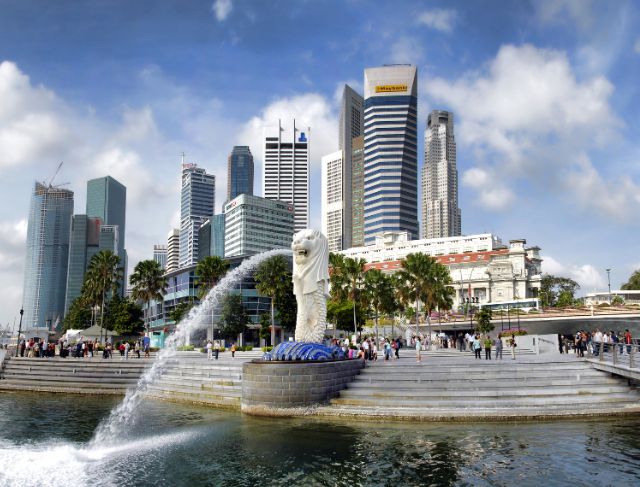
Visitors may flock to Singapore because of its reputation for cleanliness, efficient public transport, futuristic buildings, and orderly cities, but this city-state is less than tranquil according to the Noise-Free Nations Index.
In fact, Singapore has the lowest Quiet Score in the world, with a score of just 6.78 out of 100.
This ranking does not reflect noise levels measured through decibels but evaluates how suitable a destination is for relaxation based on 7 criteria, including population density, tourism density, rural land area, protected areas, vehicle density, number of airports and railways.
Higher scores indicate greater potential for peace while lower scores point to a place with high level of density, movement and urban activity.
Singapore’s combination of small area, a lot of people, millions of tourists and great transport infrastructure results in its position on the bottom of the list.
Reasons for Singapore’s Ranking Low in Terms of Peacefulness
Singapure’s ranking is connected to its geographical features.
Singapore is a small country, which reduces the chances of having vast large rural areas and untouched lands.
The area of Singapore that can be considered rural is less than 30 percent by the data utilized for ranking.
Moreover, Singapore has a high population density, about 8,436 people per square kilometer, which makes it different from other countries such as Bhutan, Namibia, and Botswana, where large territories are quite isolated from densely populated areas.
In Singapore, human activity is concentrated in a small area.
For tourists looking for places where it is possible to escape from cities completely, this can make a search for such places harder.
A Small Country with Plenty of Opportunities for Enjoying Urban Life
Due to being a small country, Singapore is not devoid of open spaces or natural green areas.
Upon reading about the Noise-Free Nations Index, you realize that it analyzes other variables related to the country and not only the existence of parks where calmness may be found by travelers.
In turn, multiple criteria must be considered in order to understand the whole reality of the country in terms of the current population, arrival of tourists, existing transport infrastructure, and the proportion of rural territories.
Taking all mentioned into account, Singapore is greatly disadvantaged by the factors mentioned above since the country attracts a huge number of people to a very limited territory.
Transportation is one more important aspect taken into account by the index.
In general, Singapore is well-developed in the sphere of various means of transportation ranging from roads to public transport systems, railways, and aviation.
The country has extended its MRT (Mass Rapid Transit) since its opening.
The transportation system in Singapore is one of the country’s most significant accomplishments.
It makes getting around the city extremely convenient and allows visitors to easily access areas where shopping, business, tourism, and local living take place.
However, from the point of view of the tranquility index, such an extensive transportation system may negatively affect the overall index.
The number of passengers who use MRT every day shows the level of urban activity in Singapore.
There are more than 3 million MRT passengers a day.
The trains travel across different areas of the city, providing contact between densely populated residential areas and commercial and tourist zones.
Major train stations become busy during rush hours when people are going to different districts.
The high level of urban mobility brings benefits for the economy and everyday life, but at the same time, it presumes that there are few areas without transportation activity in Singapore.
Hence, this fact is treated as one of the reasons that affect the level of tranquility in the country.
Changi Airport Reinforces Singapore’s Global Links
Singapore’s transportation network does not only include railroads.
Another key element in the country’s global connectivity is Changi Airport.
The facility consists of four terminals with an overall area of over a million square meters, which is equal to 156 soccer playgrounds.
Changi is an international hub of aviation connecting Singapore with destinations throughout Asia and other regions of the world.
The size of the airport hints at Singapore’s standing as the center of business and tourism as well as a transportation and travel hub.
From the tourism point of view, this connectivity can be regarded as an advantage.
At the same time, from the standpoint of the Noise-Free Nations Index, it is another factor of mobility and activity for a small country.
International Tourism is Another Factor of Crowdedness
Tourism is another aspect taken into account by the index.
Singapore is one of the leading tourist destinations in Southeast Asia, which attracts millions of tourists annually.
In 2025, Singapore welcomed about 16.9 million foreign tourists, which is 2.3% more than during the previous year.
Those tourists also created record tourism revenue of nearly USD 32.8 billion.
The figures indicate how essential international tourism is to the economy of Singapore.
They also reveal the enormous capacity of people who are entering and moving around very small areas.
The Relevance of Tourist Density
The sheer number of tourists does not equate to a crowded country.
An enormous country may host millions of tourists and still have huge unoccupied spaces.
The case is different for a tiny city-state such as Singapore.
International tourists gather mostly in popular parts of the city and attractions happening in the shopping area, entertaining facilities, cultural quarters, and famous places.
This, in turn, increases the level of activity in the areas already active.
A tourist who is looking for solitude may find it not easy to discover an area without any urban life.
Singapore’s advantages are almost opposite of the concept of the index.
There is a remarkable contradiction in the ranking of Singapore.
A lot of qualities that make Singapore desirable for tourism reduce its Quiet Score.
Efficient MRT system allows easy transportation.
Changi Airport provides great international access.
The closely-knit design of the city helps in attaining most of the city attractions very conveniently.
There are a lot of places for dining, shopping, entertainment, and culture.
The city welcomes numerous tourists each year and thus earns a huge amount of income.
These qualities indicate that Singapore is indeed a very convenient place.
But on the other hand, it should be mentioned that it lacks features typical for distant low-density traveling.
The Low Quiet Scores Does Not Mean That Singapore Is the World’s Noisiest Country
The Quiet Scores should not be seen as an indicator that Singapore is indeed the loudest country in the world.
The Index does not measure the environmental noise levels through decibels.
In fact, it looks at several factors affecting the level of noise or peace.
The visitors can still find some quiet spots in Singapore.
It is possible to relax in parks, nature reserves, waterfront areas, gardens, and not so crowded districts.
The score simply means that in general Singapore is not that type of place where people can find peace when traveling.
Maldives Is the Second on the List of the Least Peaceful Countries
The Maldives comes second on the list of countries with the least peaceful Quiet Score, which is rated 8.48.
The initial thought might be shocking.
The Maldives is known around the world for the extravagant resorts, tropical beaches, turquoise waters, and the secluded island experience.
On the other hand, the score is based not on the peace tourism offers, but on its structure.
In this regard, the location, intensity of tourist activities, and dimensions of the country are the parameters that will determine that score.
While you can visit a quiet resort, the Maldives can be evaluated low on the list.
Barbados Is the Third
Barbados is ranked third as one of the countries with the lowest Quiet Score (10.12).
Tourists come to this country due to its beaches, hotels, eateries, and spots of interest.
Just like the Maldives, there are places that can provide inspiration and peace, but in general, the indicators used by the index show that Barbados reached one of the lowest positions regarding tranquility.
Qatar takes the fourth place with 15.45 Quiet Score and it is another country to observe because of hitting a fast urbanization process, especially in the Doha province.
The nation possesses a modern infrastructure, well-built highways, operating airports, and commercial areas. As a consequence, the level of mobility is high.
Apart from that, Qatar became a well-known place in business, tourism, sports, and hosting various significant events.
Due to these factors, Qatar does not take the highest position in the ranking comparing to the countries with more peaceful atmosphere and the lack of concentration.
Lebanon is the fifth country among those that possess the lowest Quiet Scores with the result of 18.13.
Lebanon has a high number of inhabitants living at the territory of the country and densest urban areas concentrated on the territory of the nation with the Beirut district and many other settlements.
Bhutan Stands in Powerful Contrast
At the far end of the scale lies Bhutan.
The Himalayan country holds the title of the world’s most tranquil nation in the Noise-Free Nations Index.
Its credentials differ greatly from those of Singapore.
Bhutan is small in terms of population, full of mountains, has a high percentage of forests, poor railway system, and regulated tourism.
All these elements create an environment in which it is possible to travel a long distance without being confronted with crowd and transportation common in big cities.
Thus, Bhutan shows how geographic features, underdeveloped tourism, and regulatory framework may greatly impact the tranquility index of a country.
Differences between Bhutan and Singapore Are Striking
When comparing Bhutan and Singapore, we come across two extremely different tourism examples.
Singapore is based on accessibility.
After passengers arrive at the international airport and take MRT, they are able to shop and dine without going out of the busy city.
In contrast, Bhutan provides absolutely a different experience.
As its network of roads move through mountains, valleys, and forests, and it has a controlled type of tourism, tourists experience a slower pace of life.
They just attract different kinds of tourists.
Singapore suits people who appreciate convenience, efficacy, entertainment, shopping, food, and connectivity most of all.
On the other hand, Bhutan is likely to be interesting for tourists who think of nature and spaciousness along with slowness of the journey and calm as their highest priorities.
The Least Peaceful Countries in the World According to the Index
According to the data available, these five countries are the least peaceful.
Rank Country Quiet Score 1 Singapore 6.78 2 Maldives 8.48 3 Barbados 10.12 4 Qatar 15.45 5 Lebanon 18.13
The results indicate a large distance between Singapore and that the other countries that are last in the list.
A score of 6.78 indicates that Singapore ranks considerably low among countries with low population density and many nature spots.
Does the Low Quiet Score Imply Singapore Is Not Good for Tourists?
Definitely not.
The list does not imply that Singapore is an inferior country in terms of attractiveness.
Singapore continues to be one of the most advanced tourist centers in Asia.
The nation has a lot to offer – attractions and sights famous all over the globe, a wide range of food specialties, shopping opportunities, cultural activities, green parks, and efficient transport.
For tourists who wish to find a place that has a lot of entertainment and is convenient to be in, the low score means nothing.
It is only interesting to the tourists who wish to find a remote and quiet place where they could rest from urban living.
If one looks for a distant mountain retreat, Bhutan may be a better choice.
On the contrary, if one looks for a city with developed public transport, Singapore is the right choice.
The city-state has made considerable investments in nature and green projects.
Parks, natural parks, water bodies, coastline areas, and protected regions help visitors to enjoy the alternative side of the urban life.
The only difference is the size.
Though a quiet park in Singapore can give one some relief from the rush of the city, it does not affect the overall characteristics of the country.
The Noise-Free Nations Index is looking at the whole image of the country rather than the situation for a particular person in a particular area.
It is not surprising that Singapore is the last country in the Noise-Free Nations Index, as this city-state is known for its cleanliness, orderliness, and efficiency.
However, in this ranking, cleanliness is not being considered at all.
There are seven criteria concerning tranquility that are involved in this ranking and they include population density, tourists, areas of agricultural land, protected regions, transportation vehicles, regional airports, and railroads.
Factors such as a high density of inhabitants, many global tourists, an extensive network of MRT, the presence of one of the world’s largest airports, and limited countryside land all come into play here.
Countries like Maldives, Barbados, Qatar, and Lebanon follow Singapore in the respective list with the same low score.
On the contrary, Bhutan has adopted a different approach, with successful combination of low population density, plenty of untouched landscape, limited transport infrastructure, and strict regulations on tourism implying sufficient feeling of space.
To sum up, it is important that the conclusions gained from the ratings lead to the notion that every trip is relative to desired experience.
If the goal is shopping, food, entertainment, effective transport system, and life in a big city – Singapore is a great option.