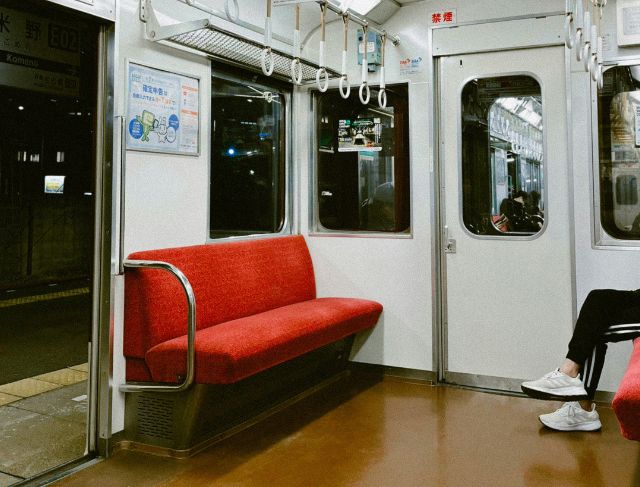
The unwritten regulations that govern Japanese society seem to be extensive enough to justify a chapter dedicated to trains. Japanese trains exemplify the quiet, organized and predictable productivity of commuting in Japan. When international guests bring some of the habits of their louder and more relaxed cultures with them into the train environment the ensuing confusion often leads to rapid escalation of unintentional conflict.
The vast majority of the behaviours that aggravate locals when they travel in Japan are not considered intentional acts of rudeness; they simply do not belong in a Japanese train environment.
Noise in a Japanese train is much more than just noise!
Loud talking, boisterous laughing and excited responses would all be the norm for travelers but when they occur on a Japanese train (in the case of language) the actual sound made is much louder than they realise. Regardless of the volume produced it will have a different level of intensity on a Japanese train.
Local people were raised within a cultural framework of quietness or low murmurs in public spaces and are conditioned to consider other forms of communication to be highly disruptive to the calmness and tranquility of their environment.
The most rapid way to create a feeling of frustration on a Japanese train is exemplified by the absence of proper usage of personal space.
Etiquette is not always clearly defined.
Some things are not posted, yet most people know what is acceptable and unacceptable.
You are not allowed to call on the phone.
You should not have your phone on, or your hands around the phone while you are talking to somebody else.
You are not allowed to sit on the floor around other people.
Eating full meals on trains is only allowed on certain trains.
Some people may think that if it is not listed as something you shouldn’t do in Japan and is not directly stated as something you shouldn’t do, that it is alright to do, but in Japan, it’s more like no one else does it, so I will probably not do it either because it makes me uncomfortable.
The Priority Seating Issue
This is tricky. The whole reason that there are priority seats for certain people who need to be seated is that, generally speaking, nobody should really have to ask.
If there is a reasonably healthy looking traveller in one of those seats it may create an uncomfortable atmosphere even if that traveller plans to stand up later.
Many locals avoid these seats for this reason. They know that there are invisible social rules that apply.
Trash Culture Shock
Many travellers may have problems understanding the lack of public trash cans in Japan. They do not understand because they expect that they will find a public trash can every couple of blocks.
But in Japan the belief is simple; you are responsible for your own trash.
Leaving empty bottles, cups, or wrappers on trains is considered socially unacceptable.
Many locals simply take their trash home with them, and many tourists may appear to be careless or irresponsible if they do not know about this.
Because of that popularity, visitors from various backgrounds and lifestyles are travelling to Japan, all of which bring their own different behaviors, schedules, and expectations with them.
Trains serve as the meeting point for all of those tourists.
According to an annual survey conducted by one of the major Japanese railways, most of the complaints that have been reported by foreign tourists are related to the train systems, with very few complaints from temples, streets, stores, etc.
Using public transportation in Japan requires a level of timing and etiquette. On busy platforms, stopping to check directions or walking against the flow of traffic can create not only an obstacle but, also, chaos for other passengers. Boarding a train before people exit, blocking the door to permit entry because you will not be getting off yet, and not being aware of what is happening around you—these behaviours may not mean that you are a “bad tourist,” but indicate that your cultural defaults are not the same as those of the Japanese people.
The good news is that gaining an understanding of the behaviour of commuters in Japan is not very difficult, and it is easy to blend in. Moving in cadence with the masses, making a conscious effort to be quiet, be aware of others in your vicinity, and watch the activity of the local population will help you to successfully navigate Japan and find acceptance, even if you only travel through the country once.