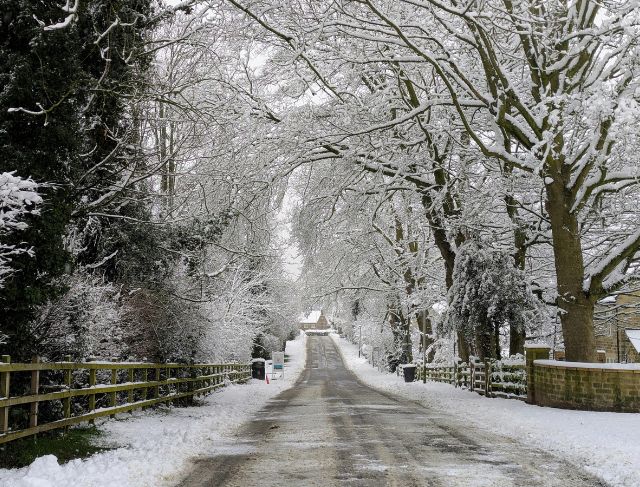
There were virtually no roads or flights in East Asia or much of Russia, while normally bustling cities were transformed into winter wonderlands overnight. People will remember this type of cold and extreme weather for years to come.
Russia has recorded its coldest winter of all time as some areas have received record amounts of snow with accumulations of several meters. Almost every type of transportation has been rendered useless in this historically high amount of snowfall.
In Shanghai, thousands of kilometers away, residents were shocked to see snow. Although snow is not common in Shanghai, the city was blanketed with snow that was several centimeters deep. People were taking pictures, getting out cold-weather clothing that they rarely wear, and posting on social media that it was hard to believe what they were seeing.
Just one week prior, the temperature in Shanghai was almost 20°C and the osmanthus trees were blooming.
A more active and energetic atmosphere, coupled with two waves of Arctic air that pushed south into warmer climates at the same time because of a disturbance in the jet stream, was what climate scientists said was happening. The jet stream is an area of quickly flowing cold air, called an Arctic polar vortex, in the stratosphere above the Earth’s surface.
The Kamchatka Peninsula in the Russian Far East saw some of the worst conditions. In the first two weeks of January 2014 alone, around two meters of snow fell in that area. To add on to that, around 3.7 meters of snow fell on that area in December of 2013. Due to this massive amount of snowfall, doors became blocked with accumulated snow, vehicles became buried in snowdrifts, and four-wheel-drive vehicles struggled to get through.
Petropavlovsk-Kamchatsky, which is a very long distance from Moscow, is where some of the really interesting pictures were being taken. There are actual photos of people walking on snow drifts as high as the city traffic lights. Many of these people had to jump off large snowdrifts because they didn’t have anything else to do after being trapped indoors for days. People have found ways to make the best out of being trapped inside.
Local blogger Polina Tuichieva stated that living in those types of conditions was exhausting, surreal, and strangely quiet.
China also experienced significant disruptions. Areas of major highways were closed in 12 provinces (including Shanxi, Inner Mongolia, and Heilongjiang) because of treacherous driving conditions caused by ice forming on the roads. The temperature plummeted south of the Yangtze River with some of the lowest observed drops recorded at Guizhou, where the temperature dropped up to 14°C.
Japan was not able to avoid the recent blizzard that hit its northwestern coast, which took place during ski season. Tourists visiting Japan expected to see snow when they arrived, but airports were not prepared for the large amounts of it.
The Japan Meteorological Agency has warned that severe weather could affect the area until January 25, and is advising people not to travel unless it is absolutely necessary.
The airline industry has already been affected by the blizzard. For example, ANA Holdings cancelled 56 flights, which impacted almost 3,900 passengers, and made a serious disruption to their holiday travel plans. Similarly, Japan Airlines cancelled 37 flights, which made travelling plans difficult for over 2,200 travellers. The majority of these cancellations were made at New Chitose Airport, which is near Sapporo, Hokkaido.
For many holiday travellers, the blizzard has meant spending extended periods of time in airports.
This winter has been very unsettling due to the unpredictability of many areas around the world, and subsequently, the weather associated with them.
Recent snow falls in Shanghai, historical snow falls in Russia, the amount of travel chaos that has occurred between Europe and Asia, and also severe weather all over the globe.
As opposed to being predictable this winter we can see dramatic changes between warm temperatures last week and freezing temperatures this week.
This winter is a reminder of how the weather patterns are changing because humans are not used to changing weather patterns. When we see arctic air dropping down into areas that are not used to experiencing arctic air on a daily basis, daily life may change dramatically.
At this point, both East Asia and Russia need to dig out of the mess, wait for their eventual thaws, and hope that they happen before it’s too late.