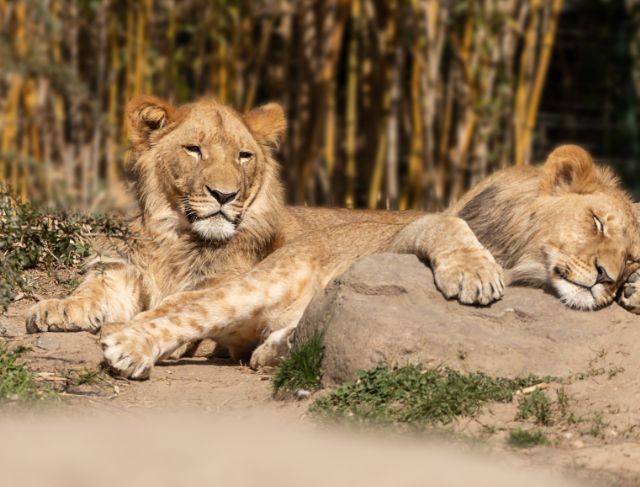
You could soon get to see how your favourite zoo animal gets treated by being able to witness a tiger getting its medical treatment through a large window – it’s going to be pretty weird and also sort of cool at the same time.
As part of its celebrations for their 200th anniversary, the London Zoo has created another huge new attraction for visitors; however this will not be another habitat or going on safari in some way.
Instead, they’re building a wildlife medical centre which is going to allow visitors to watch real vet teams care for real animals.
The centre is reportedly going to have a huge viewing area with large glass windows looking into areas where they will be providing treatment to animals as well as operating.
So the public, children, school groups, families and so forth, will all have the ability to observe the medical care of various animals, as small as penguins to large predators, like tigers.
According to the zoo, there is a chance that guests will see medical teams perform surgical procedures on the animals, provide emergency medical care, rehabilitative medical procedures, and necropsies (animal autopsies for research/conservation purposes).
The funding for the entire project is being made possible because an anonymous benefactor donated an unprecedented £20 million, which is now considered the largest single donation ever made to the Zoological Society of London (ZSL).
Jennifer’s donation has been critical in reimagining London Zoo as a combination of wildlife park and science centre, as well as a site for veterinary research.
Zoo veterinarians believe that this kind of project has the potential to encourage young people to enter careers in animal welfare, biology, conservation, or veterinary medicine.
When visiting a zoo, most people only see animals that are healthy, resting, eating, or sleeping in their exhibits and rarely witness the complex medical care being provided to endangered animals behind the scenes so that they remain healthy.
By exposing these once-secret areas to the public, it is hoped that people will gain a better understanding of the realities of modern wildlife conservation.
Furthermore, this project adds yet another dimension to both the historical legacy and the ongoing evolution of this significant institution.
As the world’s first scientific zoo established in 1826, London Zoo has had a long and rich history which has been associated with many renowned figures and creators throughout history.
Among many others, Charles Darwin is said to have formulated some of his theories at London Zoo; author Beatrix Potter drew inspiration for her characters from the animals at the zoo; and even the bear who inspired the creation of Winnie the Pooh (Winnipeg) is alleged to have lived at the zoo.
Thus, in many ways, this new medical centre continues the educational legacy of the zoo.
The new philosophy of the zoo is no longer just to showcase animals for the purposes of entertainment. The focus has shifted to help visitors learn about the science, care and conservation efforts that all happen behind the scenes at every exhibit.
Reactions to this shift in focus have begun to divide into two camps on social media.
- Some agree with the educational concept and believe it will raise the general population’s awareness of the need for protecting species and their habitats.
- Others are concerned that some of the activities being filmed, such as surgeries performed on animals or helping injured animals, may cause emotional distress or be too intense for young children.
The zoo has a lot of confidence that this new project will quickly become one of the biggest attractions!!
Watching veterinarians perform life-saving procedures on tigers or assisting with the recovery of an injured penguin, is not what most people think of when they plan their average trip to the zoo.