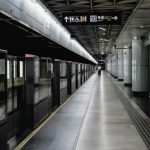
Let us examine China for a second; the country that, in the last two decades, has been constructing an outrageous number of metros. As North American and European countries are still in disagreement about contsructing trams, trains, or even subways, China on the other hand has built more subway systems in their country than the rest of the world does combined. The success lies in one term: standardization.
The Chinese Consistency
To put it mildly, every metropolitan area possesses their own rail system, and they are all entirely different. Vancouver possesses automated underground lines featuring miniature trains powered by linear motors. Suburban Calgary and Edmonton have trams and high-floor trains as part of their rural rail transit systems. French style rubber tired metros ran by the Montreal system, and Americans trains in Toronto. Ottawa has a combination tram and underground train system.
From a distance, it appears that they each built designs for their individual cities without thinking about consistency. While it has an amusing aspect to it, it does provide a lack of practicality. Each city has distinct trains and incorporates various contrasting electrical systems that make everything else challenging.
Let’s shift our attention to China now. China transformed its transportation infrastructure over the past twenty years, constructing more than 6,000 kilometers of metro lines. For comparison, this is equivalent to constructing the entire Berlin U-Bahn system forty times, or the New York underground four times. Moreover, this was accomplished through heavy standardization.
The Secret Sauce: Standardization
It’s not as though China just haphazardly constructed metro systems. They formed a coherent plan which established a singular purpose, “We are going to standardize everything.” When I say everything, I mean everything.
Train Types: In China, there are five categories of train which have been labelled: Type A, B, C, D and L. These types possess different dimensions, capacities and specialized features. Type A trains for instance, are 22 meters long, 3 meters wide, and like the trains in Hong Kong, have five doors per side.
Track Gauge: There are no locally or uniquely narrow gauge systems since all Chinese metro lines use standard gauge (1,435 mm).
Electrification: The majority have overhead lines with 1,500-volt DC. This removes any need to debate the merits of a third rail versus overhead lines.
Environmental Standards: Even more, limits on noise and its surrounding environment qualify as standards.
This level of robotization implies that every time an additional line needs to be constructed, a different train planner does not need to go through the fabrication process from scratch. The planner simply selects the type of train, calculates the necessary number of cars, and they are good to go.
Why Standardization Works.
Standardization is more than the simplification of tasks; it is about making them less costly and much quicker to complete. A national standard means that trains as well as tracks, and even components such as stations can be manufactured on mass. This lowers the prices easily and accelerates the development.
Let’s say, for example, that you want to add an additional metro line to Chengdu. You will not have to waste months pondering over the type of train you will use, or the width of the platforms. Merely glance at the national standards, choose a Type A train, and commence construction.
Furthermore, all things being equal helps engineers and planners switch projects without a moment’s pause. The team that worked on the metro line in Hangzhou is then able to travel to Qingdao and build a very similar system. A loop of advanced skill and productivity is created.
The Results: A Metro Network that is Better than the Best
Due to the Standardization,China has built metro systems at an unprecedented scale and speed. Chengdu, Guangzhou, and Shanghai are now some of the biggest and most sophisticated cities in the globe with metro systems within a decade or two.
However, it’s not purely about quantity. Chinese metro systems are tremendously proporitioned. Platforms are industrialized, therefore, stations are built in the shortest time at affordable prices. Safer and more efficient stations are made possible because screen doors are ubiquitous. Furthermore, standardized trains lead to effortless and inexpensive maintenance.
What Can the Rest of the World Learn?
Metro efficiency construction is something every country should take notes from China. The ability to standardize everything to enhance output and minimize spending is something not all nations have. Even though not every country has or wants to chance to use China’s top down hypothesis, they can still learn these valuable metrics.
- Make Decisions Faster: Standardization removes protracted discussions over train kinds, electrical systems, and even track widths. This lowers expenses and hastens overall planning processes.
- Take Advantage of Economies of Scale: Construction speed and expenses are significantly reduced by the mass production of standardized parts.
- Keep Your Eyes on the Prize: Without having to master the nitty gritty, one can allocate resources to real issues like how to optimize motion for individuals.
The effective standardization of China’s metro construction serves as an example. They have been able to construct some of the most efficient and largest metro networks in the world due to the establishment of a national platform for transit systems.
Therefore, the next time your city gets into a quarrel regarding whether a streetcar or a subway system should be constructed, consider this: more often than not, the answer is the least complicated one.