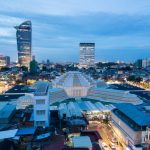
Imagine this: You are out and about in Phnom Penh riding a scooter while maneuvering through tuk-tuks and scooters with no regard to traffic rules. People aren’t really using them if they do exist. “Should I signal? Nah. Nobody else is!” At last, in Cambodia the cradle of ancient temples and long built infrastructure indeed quite fascinating.
As I walk around aimlessly in stunning marvel, I start recalling Angkor Wat. No, it’s not a dream. That stone temple surrounded by equally stunning man-made moats is regarded as pride of Cambodia, it honestly quite lavish if you really do think about it. Iconic? They plastered it in the flag without hesitation. Quite narcissistic, just like every other country and what does the flag contain? Simple yet powerful blue, red and white. Ending their statement with pure streamlined Buddhism.
What most misses their point about Cambodia is the flexibility that comes with it as Buddhism. The dominating religion not only of the country, infamously known for the willing surrender of citizens but the word “peace” attempts to cover hot places like human trafficking and landmines still roam around.
Can be described as dirty. Unfortunately rural Pood reloaded give remnants of a once thriving, strong modernized country that now bounds in freedom like a pogo stick waiting to be unleashed while simultaneously feels like living in an abandoned Disneyland waiting for people to come visit.
Currently, the reason for this is due to leftover landmines from the multi-decade conflicts. During the worst period in the Khmer rouge reign, the regime singlehandedly eliminated almost a fifth of the country’s population which sat at around 8 million, in just a few years in the 1970s. Monks, teachers, and even intellectuals who were more than vulnerable to getting assassinated were incredibly and unreasonably viewed as a threat, and were subsequently eliminated. All of this resulted in pure chaos.
Similar to the bounce-back from a boxer who was hit hard, Cambodians were able to recover, albeit in a staggered manner. The massive demographic shift you are witnessing is a direct result of the baby boom the country experienced post-genocide.
The largest freshwater lake in Southeast Asia not only enriches its natural beauty but also grows and shrinks depending on the season and sustains over two-hundred species of fish. Speaking of fish, their soaked celebrity is none other than The Giant Barb. This titan of a freshwater fish certainly puts Japan’s tuna to shame.
Let’s move on to something new: food. Tend to it a cuisine abundant with fresh spices and vegetables, and yes, bugs. Low in fats, cheap and extremely nutritious – fried crickets, roasted beetles, and even spicy scorpions.
Cambodia carries the heavy influence of Theravada Buddhism alongside centuries-old Khmer traditions. The Khmer language (pronounced “Kuh-Mai” not “Kuh-Mair”) allows for faint interactions with Thai and Lao speakers, but Vietnamese? That’s an entirely different story.
Cambodians still manage to get by considering the climbing GDP. Approx. $2.60 a day is what people here earn on “average,” but this does not stop the relentless setting up of shops, moped repairing, and serving steaming hot soup noodles to tourists. Here, entrepreneurship is the first sign of survival.
More than 80 islands are located off the southern coast, and many are a stone’s throw away from the mainland. Siem Reap is where you want to fly to if you plan on visiting Angkor Wat, which is way easier than taking a bus from Phnom Penh (and less sketchy) .
Cambodia is not politically aligned with any country considering they have not had a soft patch with any of the countries. Thailand and Cambodia do not get along because of ancient temples, and Vietnam keeps a parent-like watch that complicates things even more. However, Cambodia gets along well with China, Japan, and South Korea who are rapidly building roads, malls, and infrastructure. France has a soft side, helping fund universities and even teaching French in some schools, so they have not completely turned their back.
No way, right? Check this out: he’s part French and speaks Czech fluently. Now that’s a unique skillset for a king.
In any case, Cambodia is a blend of scars and strength. A nation that bravely endured one of the hardest hits to its history and remains standing. From fuel bottles amid greenery to tragic pasts suffused with hopeful tomorrows, some places feel like the future waiting to unfurl, and Cambodia feels the most vivid, and one moped horn at a time, the story continues, still in the process of being crafted.
Hotel in Cambodia
- Angkor Wat: Raffles Grand Hotel d’Angkor
- Bayon Temple: Shinta Mani Angkor
- Ta Prohm: FCC Angkor by Avani
- Banteay Srei: Banteay Srei Homestay
- Phnom Kulen National Park: Kulen Retreat
- Tonlé Sap Lake: Sala Lodges
- Kampong Phluk Floating Village: Angkor Elysium Suite
- Choeung Ek Killing Fields: The Plantation Urban Resort and Spa
- Wat Phnom: La Rose Suites
- Independence Monument (Phnom Penh): Aquarius Hotel & Urban Resort
- Koh Rong Island: Sok San Beach Resort
- Koh Rong Samloem: The One Resort
- Bokor Hill Station: Le Bokor Palace
- Kampot River: Rikitikitavi
- Kep National Park: Knai Bang Chatt
- Crab Market (Kep): Veranda Natural Resort
- Cardamom Mountains: Cardamom Tented Camp
- Preah Vihear Temple: Preah Vihear Boutique Hotel
- Banteay Chhmar Temple: Banteay Chhmar Homestay
- Phnom Penh Night Market: Okay Boutique Hotel
- Central Market (Phnom Penh): Sun & Moon Urban Hotel
- Siem Reap Old Market (Psar Chaa): Viroth’s Hotel
- Artisans Angkor: Golden Temple Hotel
- Cambodia Landmine Museum: Angkor Village Hotel
- Beng Mealea Temple: Beng Mealea Homestay