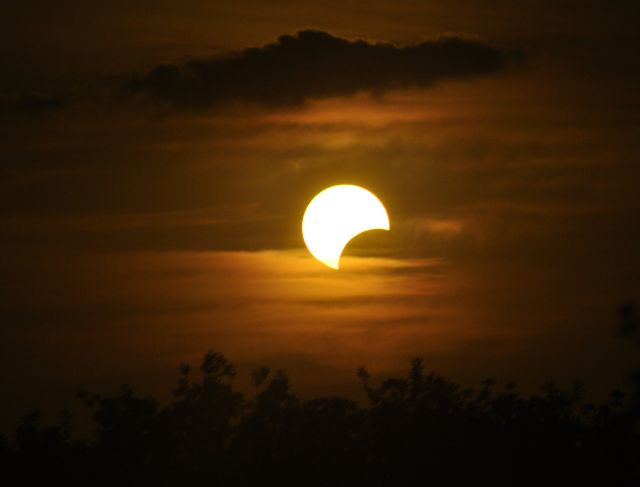
An extraordinary event is being expected in the night sky with the arrival of the lunar eclipse that will occur when the Moon slides into the shadow of the Earth. In the course of this natural phenomenon, Earth will cast its shadow onto the lunar surface covering approximately 96 percent of the Moon, which will then look reddish in color.
The eclipse is expected to be visible in many parts of the World giving a chance to billions of people to witness the natural goings-on in the sky.
People in North and South America will have some of the best conditions for watching the eclipse, while those located in Europe, Africa, Middle East, and some regions of the Pacific will be lucky to observe at least a part of the eclipse.
What is going on during a lunar eclipse?
Lunar eclipse takes place when all three celestial bodies – Sun, Earth, and the Moon find themselves in a straight line, with the Earth obstructing the rays of the Sun that normally reach the Moon’s surface.
A lunar eclipse will take place on the upcoming night. Since the Earth, Moon and Sun won’t be in a perfectly straight line, only a part of the Moon will pass through Earth’s conical shadow only partially.
This is a reason for the lunar eclipse to be a partial one.
More Than 95 Percent of the Moon Will Be in Shadow
The fact is that even though the eclipse is partial, it will be quite impressive.
Something like 95-96 percent of the Moon will be covered with the Earth’s shadow at the peak of the eclipse. It means there will be only a little bright area on the Moon’s surface.
Watching the Moon during the eclipse one can notice how the Moon becomes darker and darker during the eclipse.
Why Will the Moon Appear Red-Orange in Color?
A lunar eclipse’s most common feature is the color of the Moon.
Sunlight enters the Earth’s atmosphere where blue waves are scattered and red and orange waves are able to reach the Moon intact.
Light gives a reddish or orange tint to the moon.
However, since this is not a total eclipse, the whole Moon cannot be called a blood moon.
Instead, people can see the light and dark areas on the lunar surface which creates a unique spectacle.
The lunar eclipse takes place about 14 days after a solar eclipse happened over Greenland, Iceland and Spain.
This is actually quite common.
Solar and lunar eclipses usually occur one after another because both events depend on the positions of the Sun, Earth and Moon.
Solar Eclipses take place when the Moon comes between Earth and the Sun and cuts off the sunlight from falling on parts of the Earth.
In the case of the lunar eclipse, we have Earth obstructing the sunlight from reaching the Moon.
In certain cases, both types of eclipses can happen one after another.
How Long Does a Lunar Eclipse Last?
People who want to observe lunar eclipses will not be in a hurry!
During the partial lunar eclipse, the partial eclipse lasts over three hours. The totality of the eclipse takes much longer.
The whole occurrence lasts for roughly about five hours and a half, and from the moment when the Moon begins crossing the outer edge of the shadow to when it completely exits the shadow, the whole event lasts approximately five and a half hours.
The long duration of the lunar eclipse enables one to see the Moon in different phases.
Unlike some astronomical phenomena that last just a few minutes, the process of the lunar eclipse gives one time for watching how the shadow creeps on the surface of the Moon and occupies more and more space gradually.
When Is the Climax of the Eclipse Expected to Occur?
The highest point of the eclipse will most probably be experienced shortly after midnight in the Eastern Daylight Time zone.
The nature of the experience will vary considerably depending on the location of the observatories and the situation with the weather in the area.
Those who are located in the regions where the Moon is at the highest point above the horizon will have an exceptional opportunity to see the celestial event.
Weather conditions have to be just perfect, and the sky must be clear for people to experience the eclipse. In other words, the clouds will simply make the celestial show invisible even if the celestial event represents a considerable event.
Billions Will Be Able to Witness It
The dimension of the viewing opportunity is quite big.
Although it all depends on the weather, billions of people from North America, South America, and Europe to Africa and the Middle East might be lucky enough to witness the phenomena.
It is estimated that almost one billion people living in the USA, Canada, and Central and South America will be able to see the complete eclipse.
North and South America Offer Great Eclipse Viewing Opportunities
Americans find themselves among the places where the eclipse can be viewed easily.
The phenomenon of the Moon will take an important time during the totality, and the observers will be able to track the changes from the initial stage to completion.
Thus, for those who are new in astronomy and people who “just” watch the night sky, the Americas offer some of the best chances for watching it.
It is important to note that since it is bright enough all detailed skyviews can be observed without using telescopes or other professional equipment.
Europe, Africa, and the Middle East Are For Less Lucky Observers
However, this cannot be said for Europe, Africa, and the Middle East.
In these regions, the destruction of the Moon will happen too early.
As a result, it can be observed only what is left before going into the shadow.
The viewing time will differ from one region to another.
Those in areas where they plan to photograph the phenomenon must plan accordingly, as the window for catching the event will be significantly shorter.
Hawaii and the Eastern Pacific Will Experience a Different Phenomenon.
Those in Hawaii and around parts of the eastern Pacific will view the occurrence from the other side.
Instead of observing the moon set during the eclipse, the moon will instead rise after the eclipse started, thus making it impossible for people to witness the beginning of the phenomenon.
People will still be able to see the phenomenon from its later stages when the moon has risen.
The difference between locations showcases how Earth’s rotation affects human perspectives of the same celestial event.
This Is the Second Eclipse of the Year.
The coming occurrence is the second lunar eclipse out of the four total eclipses that have been recorded in the year.
Different viewing experiences come with the two eclipses.
If a total lunar eclipse is a phenomenon wherein the Moon travels into the Earth’s darkest shadow completely, a partial lunar eclipse happens when part of the Moon remains outside this shadow.
The upcoming event is promising to be spectacular although it is not going to be the same as the expected total eclipse that has taken place earlier this year.
When Is the Next Total Lunar Eclipse?
If people are expecting to see another total lunar eclipse, they will have to wait a long time.
The next total lunar eclipse is supposed to take place on 31 December 2028, when Asia and Australia will have the best conditions for watching it.
In this case, it is crucial to understand that sky-watchers from North and South America will not be able to view the total lunar eclipse before 2029, meaning that the partial eclipse makes a good opportunity for one who loves watching celestial phenomena.
How to Watch a Lunar Eclipse
It’s easy to see a lunar eclipse if compared with many other astronomical phenomena.
If you intend to watch a lunar eclipse, you will not need any special eye protection or instrument to see it. You can comfortably watch the whole event with your naked eyes.
For the best view of the lunar eclipse, choose a place where you will have a clear view of the sky and do not have any obstructions.
Rooftops, open fields, beaches, balconies, and other elevated places will give you a great vantage point as long as you can see the horizon.
Make sure to check the weather beforehand because the Moon can be covered by clouds.
The Reasons Why Lunar Eclipses Are Interesting
Lunar eclipses can also serve as good examples of the principles of celestial mechanics.
Although it may look simple from our perspective, the whole process is based on the perfect relationship and position of three moving bodies – the Sun, the Earth, and the Moon.
The movement of the Moon around the Earth and the movement of the Earth around the Sun cause the constant change of their position in space until the latter finds itself in the right position in terms of geometry.
The reddish hue serves as a subtle reminder of the role Earth’s atmosphere plays in the appearance of the Moon.
An Astronomical Event That Will Be Seen Around the World
One of the most striking features of this partial lunar eclipse is how widely it can be witnessed.
People across North America and South America, Europe, Africa, and the Middle East will all have a chance to look up at the sky and observe this phenomenon.
The only difference is that visibility in each location will occur at different times.
Despite those differences, however, the event has something universal in common.
Various observers around the world will enjoy the same heavenly view as they will be able to see how the shadow of the Earth changes the appearance of the Moon.
The period of the partial stage of a lunar eclipse spans for a period of over three hours, but the overall activity of the Moon starting from the entry into the Earth’s shadow until it leaves will take a little over five hours.
The people living in North and South America will have the greatest chance not to miss out on the total course of the eclipse, although the residents of Europe, Africa, and the Middle East will be lucky enough to see the Moon coming up over the horizon even before the total eclipse takes place.
Even though it is not possible for the moon to be able to get into a red state, it would be very nice to have some orange shades in the process due to Earth’s atmosphere.
Moreover, as a great number of residents from all the continents will be able to have a look at the moon without any additional preparations and means of transport.