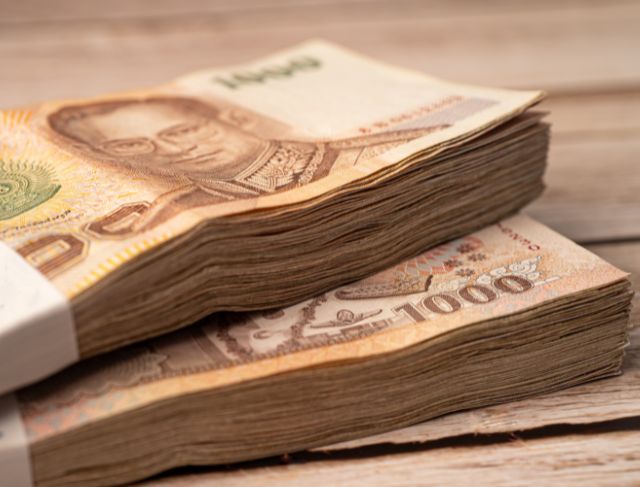
While Thailand’s tourism industry appears to be thriving, the strengthening of its currency may be inhibiting profit growth within the industry. Industry professionals are beginning to have concerns about the long-term implications that a stronger baht may have on travel to Thailand versus the other economies in the region.
The growing apprehensions are not about any immediate decline in tourist arrivals, rather they are centered around a scenario where the baht continues to appreciate versus the US dollar and other currencies; thus, impacting Thailand’s level of competitiveness as a desirable tourist destination long term.
A former head of Thailand’s Tourism Authority expressed that if the baht appreciates beyond THB30/USD, then there could be a corresponding tourism revenue decline of 15-17%. In a country heavily dependent on tourism to support the national economy, a 15-17% decline would have a significant negative impact.
When the baht appreciates, the cost of traveling to Thailand for foreign tourists will be higher because all costs associated with travel – airfare, accommodation, food, tourism activities – will be converted from the traveler’s local currency to baht and the result will be a higher cost when converted to baht.
As a result, long-haul travelers from Europe and North America may be forced to reconsider traveling to Thailand if costs become too high, while Asia-based travelers will most likely consider travel to other Southeast Asian countries such as Vietnam, Indonesia, or the Philippines where travel costs would most likely be lower than to Thailand.
Current exchange rates of 30-32 Baht/USD are still seen as an acceptable range of exchange rates. Also, many tourists are more concerned with experiences, food, safety, and comfort rather than comparing small variations in the international currencies.
Thailand remains a desirable destination and many tourists are still going due to the beaches, culture, wellness, and street food.
Tourist spending per visitor is currently low for Thailand compared to many other leading Asian tourist destinations. Average daily tourism spend in Thailand is approximately $300/visitor compared to destinations like Japan, or Singapore, where average daily tourism spend is 600-700 dollar/visitor.
There continues to be an opportunity for Thailand to continue to pursue a more high-value hospitality tourism model versus just a high-volume visitor tourism model.
Therefore, rather than just considering exchange rates in providing services/products, Thailand’s tourism sector is being asked to develop upgraded services/products. Examples of upgraded services/products are medical tourism, wellness retreats, premium MICE events, and digital nomad hubs.
Thailand has the opportunity to be viewed as a calm neutral location in a world with political unrest and economic instability.
Visitors come to us not only for vacations, but also for recovery from work, to conduct business, or simply for an extended amount of time.
Hotel bookings during this year’s Songkran holiday are expected to be depressed about 5-10% less than they were last year due to the increased cost of travel and uncertainty regarding gasoline supplies causing many travelers to be more frugal.
Chiang Mai has serious problems with air pollution that may prevent some tourists from visiting, and Krabi has experienced a higher-than-normal level of flight cancellations. Domestic travel has also caused many travelers to rethink whether or not they want to make a long drive, such as from Bangkok to Chiang Mai.
Many hotel and lodge operators are not raising room rates for this year; rather, they are keeping their rates the same but providing additional incentives to attract guests through promotions, enhanced services, and special offers in order to maintain stable occupancy levels.
Maintain low cost to encourage tourism, and allow time until the world’s economic conditions clear up.
Overall, there isn’t currently a tourism crisis in Thailand; however, the industry is entering an uncertain period regarding foreign currency rates, natural disasters, wars, fuel prices, and competing countries.
Thailand will continue to be extremely attractive to consumers, have great products for tourism, and have loyal tourists from all parts of the globe.
This means providing a better product, using better planning, and giving each tourist value for their money.