
Once, Iran was at the forefront of one of humanity’s most peace-loving commercial networks, the Silk Road, not only as an interval on the route but more importantly as one of the main links between the two parts of humanity.
A common perception of the Silk Road is that it was one route of many. It was actually a huge network of trading routes that linked many parts of the earth’s surface together. Both continents were connected by trade, with major trading links from East Asia to the Middle East across Central Asia to Europe (i.e., North and South America were excluded from this commercial trade network), thereby exchanging goods, ideas, and culture with each of those continents.
The overall growth of these commercial routes between the establishment of their first element (i.e., by the Han Dynasty of China about 220 BCE to 280 CE, at approximately 2,000 years after; generally, historians agree that commercial trade along these routes started shortly thereafter) to their last period of trade activity (generally agreed by historians to have ended around 1600 to 1800 CE) represents a long-period of trade activity across these trading corridors that continued for many centuries.
In the centre of these commercial corridors was Persia (modern-day Iran).
Overall, Persia’s location served as an ideal portal for Chinese goods commerce destined for the Mediterranean world because of Persia’s geographic position; merchants attempting to pass from the East to the West typically entered the Persian Empire prior to making their businesses west.
Iran’s advantageous location has led to its rise as a thriving center for trade.
An example of this development is the construction of the Royal Road by the Persian Empire in approximately 500 BCE. This significant infrastructure development greatly improved communication and trade across the immobilized territory of Persia by providing a much-needed means of transportation.
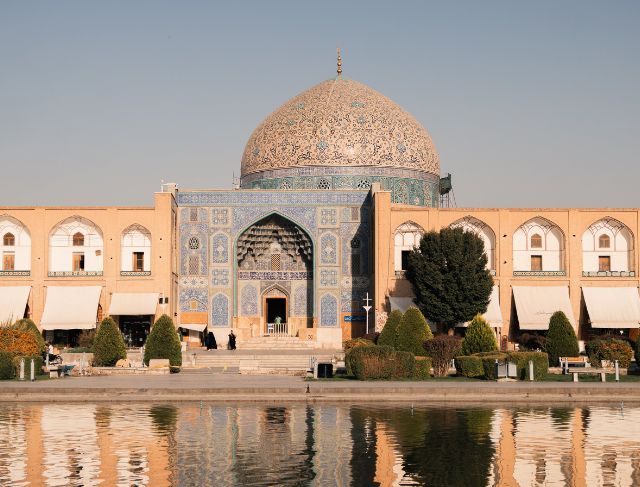
As trade grew, many cities in Persia became major international centers of commerce – including Tabriz, Nishapur and Isfahan – and served as meeting areas for traders from all over the world.
These international markets are not described as “small local bazaars.” Valuable goods required to trade globally, such as paper, gunpowder, carpets, precious stones, metals, textiles and spices, were exchanged at these locations; luxury goods from China and eastern Asia regularly passed through Iran en route to Europe.
Although China produced a great deal of world-renowned goods, particularly silk, Iran served as a major distributor and connector by virtue of its strategic geographic location.
The Persian Empire developed many facilities to serve long-distance travelers. Caravanserais – large inns constructed along major routes for merchants and their camel caravans – are perhaps the most notable invention of the era and played an important role in the expansion of commercial activity.
Caravanserais were more than just inns or shelters; they were multi-faceted establishments that provided traders with the means to temporarily rest and store their goods, and they provided water and safety to subjects of the Persian Empire traversing desert and mountainous terrain.
Sharaf Caravanserai, Ahovan Caravanserai, Qoosheh Caravanserai, and Bisotun Caravanserai are only a few notable examples found within Iran of these rest stops along trade routes.
Trade was made significantly easier along the thousands of kilometres of trade that took place along the Silk Road, thanks to these individual rest stops along the way.
The Silk Road was never just about the exchange of material goods;it also provided an extensive network for the exchange of culture.Through trade, ideas, artistic styles, and technological advances were transferred as traders travelled from region to region.Persia played an essential part in this cultural exchange.Persia exported art, architecture, and craftsmanship throughout Central Asia and into the Mediterranean. Persian motifs and building technologies developed in Persia influenced the architecture of regions far beyond the borders of Persia.
Additionally, the Silk Road assisted with the distribution of religious beliefs in Eurasia;and Persia was one of the main junctions of that distribution process.Merchants and scholars travelled to different locations, bringing along with them texts, philosophies, and knowledge regarding various religions such as Zoroastrianism, Buddhism, Christianity, and eventually, Islam in that order from east to west.
Furthermore, scientific ideas and philosophical texts were translated and critically evaluated by Persian scholars; thus, aiding in the proliferation of knowledge across cultures.
Interestingly, the actual term “Silk Road” did not exist until the 19th century when it was introduced by German geographer Ferdinand von Richthofen in 1877.
The historical significance of the Silk Route is still extensively examined today. Iran has a dedicated center for research on the Silk Road at Shahid Beheshti University in Tehran. One of the works done there deals with Iran’s role as a cultural link within this ancient networking system.
Modern projects are still attempting to create continuity with that heritage. In 2016, The World Silk Road Cities Assembly held an event at a caravanserai in Qazvin, to promote cooperation between countries along the ancient trade routes.
You can still find vestiges of that prosperous time when you travel in Iran today.
Across Iran, there are archaeological sites from the Silk Road. One is Persepolis, a ceremonial capital of the Achaemenid Empire founded by Darius I in the 6th century BC, has great limestone staircases, vast relief sculptures depicting delegates from other cultures bringing tribute to the emperor.
Another is the Golestan Palace in Tehran, listed by UNESCO as a World Heritage Site because of its combination of traditional Persian style with imported European architectural influences, during the time of the Qajar dynasty.
Subsequently, there is also the Jameh Mosque of Isfahan, dating back to before 1100 AD, which is the first mosques constructed. The layered dome design and four-court courtyard layout served as the model for many mosque structures across all Central Asia & Middle East.
Additionally, some cities, which were ancient fortified towns, such as the city of Rayen, show the importance this area had in guarding the Silk Roads for merchants.
Additionally, caravanserais (inns) continue to be identifiable worldwide as a major symbol of many long-distance trade routes in ancient times.
Most of the time when people think of the Silk Road, they think of Central Asia or China. However, they are missing that the entire network would have different if Persia had not been involved.
For over two thousand years, Persia (now Iran) provided a bridge between goods, cultures, religions, and ideas on both sides (East and West) bringing changes to the entire world.

