For many people who are visiting, arrivals at Bangkok’s airport and/or hotel are only the first steps in their journey. The real adventure begins as soon as they take their first breath of the smoke from grilled squid and stinky tofu that combine with spicy noodles being cooked on charcoal grills by vendors set up in different places throughout the streets.
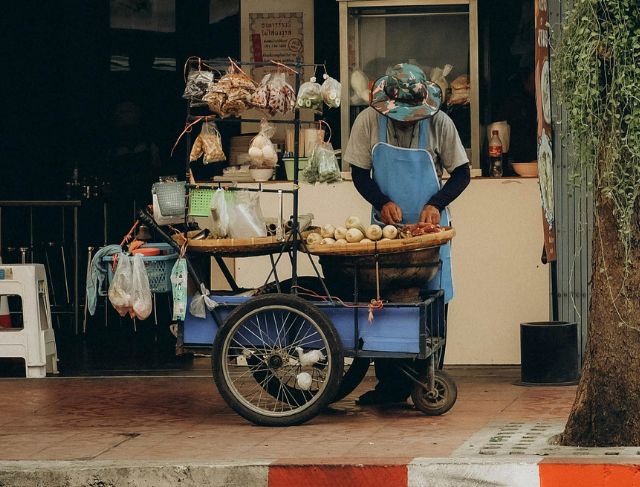
Changes made by the local government to the sidewalks around the whole city are currently placing thousands of street food vendors under a lot of pressure to change their normal operations. The sidewalks that use to be filled with plastic chairs and street food carts and vendors cooking with charcoal grills and a crowd of people heading to/from their homes and late-night partying now look more organized, less cluttered, and wider. To the city officials, this is a sign that they are moving in the right direction. However, for many of the street food vendors, it just feels like their next meal and where they will be able to sell it is uncertain due to the constant inspections.
Many of the vendors selling street food in Bangkok realize there are so many people who travel to Bangkok solely for the street food, whether it’s to eat Pad Thai on the street, grab some mango sticky rice at a roadside stand, or get some grilled seafood after midnight at a street vendor in Chinatown, that the line connecting tourism and street food can no longer be differentiated.
Bangkok has seen a decline of over 60% in its street vendors since 2022, as per the data from the Bangkok Metropolitan Administration (BMA). About 10,000 street vendors have vanished from public sidewalks.
Some vendors have relocated to new government-sponsored food courts. Many street vendors have closed their businesses because they cannot find affordable relocation options, and increasingly difficult conditions have forced them out.
The authorities do not want to eliminate street food entirely. Instead, city leadership is attempting to relocate street vendors into designated hawker centers like the organized food courts in Singapore. By doing this, the government hopes to improve cleanliness in the city and provide better access to pedestrians while being able to organize the activity of the city.
A noodle vendor who relocated recently to an indoor location near Lumphini Park said it is much easier to work in the new venue than on a sidewalk; she now has access to electricity, more-clean facilities, running water, and protection from the heat and rain in Bangkok. She said that she now has improved working conditions than before.
Many older vendors fear that they will lose their steady customers if they leave established, traditional locations frequented by tourists. Many of the vendors have sold food in the same location for over 20, 30, or even 40 years.
They will lose their routines, the associative communities they built, and the long-term loyal customers they established over the years.
There appears to be a split between many tourists regarding the transition. On one side of this spectrum, visitors approve of clearing up sidewalks and creating less traffic congestion; on the opposite side, there are tourists who feel Bangkok will lose an essential ingredient (the chaotic energy of street food) if it becomes modernized and less disorganized. A German tourist recently stated that one of the best experiences they have ever had eating has been through Thai street food, and they hope that none of this flavor will be lost to change.
Bangkok wants improvements like modernization (cleaner infrastructure), organization, and public spaces. However, one of the reasons why Bangkok has such a strong identity in North-America and around the world is its chaotic, crowded, and noisy food street culture. To be ironic, the same street vendors who were once criticized by the city for blocking sidewalk space are now viewed by many as being a major aspect of Thailand’s tourism identity.
While Bangkok continues its efforts toward modernity, there is still a concern of if the city can do this without eliminating the portion of the food culture that most travelers are traveling there to experience.